

Educational Curriculum
i
Our Simulation courses| Lecturer | Professor from each faculty |
|---|---|
| Sign-up Deadline |
Our center has started to promote simulation in medical courses since 2008,our main courses include TRM (involving 3 faculties, 13 teaching plans), GOSCE (involving 11 faculties, 6 teaching plans) and iOSCE (involving 5 faculties, 14 teaching plans).
Till now, a total of 11 faculties have participated in these courses with an output of 33 teaching plans. Nevertheless, in order to improve students’ adaptability in future careers and to help students succeed in the National Examination, each faculty has implemented OSCE to encourage students’ performance in simulation exams. A total of 27 teaching plans were developed with the participation of 9 faculties.

1. Team Resource Management (TRM)
During the internship, students will engage with tedious clinical worl that may not yet have been taught. By simulating the workplace, we hope that students will learn how to cooperate with the others in the medical team, so as to successfully compete each task. Throughout the course, students will be able to know that leading a team involves the knowledge of resources management and also medical laws and ethics, other than just communication skills.

2. Group Objective Structured Clinical Examination (GOSCE)
We are hoping to incorporate the education of medical humanities; medical laws and ethics; and effective communication skills in our simulation-based medical courses in the following two years with the involvement of faculties. This would lead students to be more observant and critical in discussions and be reflective to professional feedback. This would also enhance their leadership, communication skills, team building and their personal and professional behaviors. By conducting GOSCE, we have constructed our curriculum by incorporating simulation-based environments - including people and equipment - as a formative clincial assessment tool to improve teamwork among faculties before students' clinical exposure in future.
3. Integrated Objective Structured Clinical Examination (iOSCE)
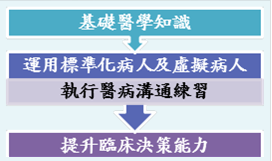
In order to improve students' clinical skills and implement the results-oriented teaching model, the teaching scheme included all the professional clinical skills that student need to be occupied with before they step into the society. Besides passing the National Examination and OSCE, stuedents of all healthcare occupations will need to strengthen their ability using the knowledge in decision-making and communication skills with doctors and patients in clinical diagnosis and treatment before they graduated. Hence, iOSCE was designed to simulate the learning of diagnostic skills with online virtual teaching software (Diagnosis & Reasoning, DxR) in conjunction with the digital teaching matericals.
4. Virtual Reality (VR)
By introducting the VR teaching materials for advanced cardiac life support (ACLS), trainees can choose to clearly see from diffent perspective how the emergency team can work together smoothly and successfully rescue patients who have lost their pulse due to myocardial infarction.